Critical Value of Isolating Utility Services Prior to Demolition!
When a building is set for demolition, one of the most important but often overlooked elements is that of the isolation, along with disconnection, of utility services.
22 Sep 2026

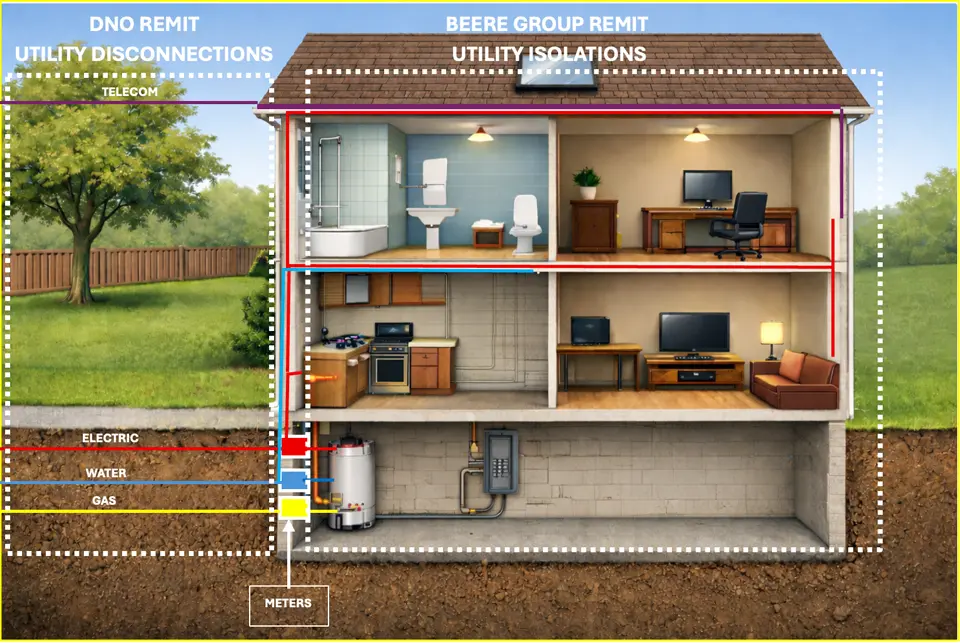
Above: Residential building as an example but this could be commercial/industrial premises, hospitals, military bases.
22 Sep 2026
When a building is set for demolition, one of the most important but often overlooked elements is that of the isolation, along with disconnection, of utility services.
It’s not uncommon, in our experience, for clients to approach us with a demolition schedule already planned out – but without having full visibility of all the services on their site or the related disconnection timeframes required to have these removed.
When it can take anywhere between 3-4 months for services disconnections to be completed, by not factoring in isolations/disconnections within your planning, it can create both delays and associated cost implications for your development.
To understand the role and benefits of utility isolations it’s important to know the difference between disconnections and isolations.
Disconnections: Encapsulates all cabling and pipework which originate from outside your site and travel to the meters within your property. This cabling/pipework is under the remit of various Distribution Network Operators (DNO) (Companies like Cadent, SGN, UKPN, SSEN, GTC, Thames Water, OpenReach, Virgin etc).
It’s this cabling/pipework where a request must be made with the respective DNO to have them disconnected so your site can be completely demolition ready i.e. no chance of DNO infrastructure being damaged during the demolition process or it causing harm to any site operatives.
Isolations: Encapsulates all cabling and pipework which travels from these meters within the building or site. Essentially all this pipework and cabling needs to be isolated back to the meter so there is nothing live within your building except at these meter points. Typically, isolations cover off the following:
From gaining a complete understanding of all services on your site, protecting both your site workforce and 3rd parties through to getting an early start on demolition soft strip, below outlines the value of starting isolations as soon as you get vacant possession:
1) Making a safe work environment, reducing your potential liability and protecting important credits
Conducting isolations of utility services will make your site substantially safer by reducing the potential likelihood and liability of harm should 3rd Parties break in and sustain injury from live electricity or damage from gas and water leaks.
Once a site is isolated, it enables demo teams to safely start initial demolition processes such as soft strip safe in the knowledge that the risks associated with live services have drastically been reduced.
2) Reducing Utility Services Curveballs & Any Additional Costs
If there are going to be any curveballs such as hidden substations, secondary rogue gas or electrical supplies, shared services – it’s when the isolations are carried out that these elements come to the surface.
Hence the importance of doing isolations as soon as practically possible, by doing these prior to disconnections being raised it enables you to get a more complete site picture in terms of what services are actually located on the site. Meaning a more accurate assessment of what disconnections/diversions are required or whether proposed temporary building supply locations are possible.
3) Documenting The Process
Once a building has been isolated you should get a report of what services were found, where they were located, proof of the isolations undertaken (gas purge certs etc, meter removal confirmations etc) as well as, most importantly, details of any areas that may still contain live services.
At Beere Group our isolation reports include all above as well as meter locations, meter serials, meter readings, details of any non-metered supplies located – basically all the information required for the next phase – Applying for disconnections.
At Beere Group we conduct a full services sweep and clear of a site at the same time as we are undertaking any electrical isolation works. This is designed to achieve two important things:
1) Ensure all electrical services back to the meter are confirmed dead and there are no rogue/shared supplies present powering other parts of the site or your neighbours’ properties (surprisingly a common scenario particularly in London).
2) Capture all other services present, how they a structured across the site and any forthcoming challenges we anticipate from these, along with next steps for their decommission.
Above provides our clients with a far more real-world boots on the ground site picture that goes beyond any desktop survey information and facilitates a clear and concise plan of action to be created around the full decommission of a site.
We hope this article was useful. If you’d like to know more about how we can help you decommission your sites or provide services consultancy on new/proposed site purchases please get in touch via [email protected] or 01483 345 490.